Taekwonder Park
east-asia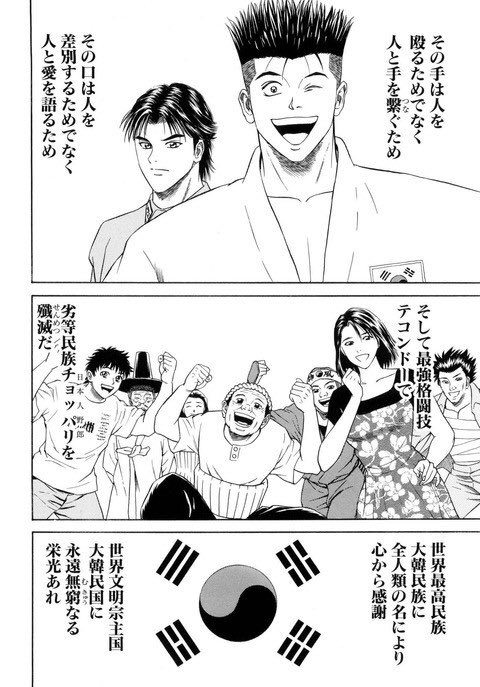
その手は人を殴るためでなく人と手を繋ぐため
hands are not for beating people up; they are for holding the hands of others
その口は人を差別するためでなく人と愛を語るため
mouths are not for discriminating against people; they are for talking about love with others
そして最強格闘技テコンドーで劣等民族チョッパリを殲滅だ
and the untermensch known as jjokbari will be exterminated by Taekwondo, the strongest martial art
Ostensibly a 「人権派格闘技漫画」, it contains a silly amount of tropes that CJK netizens hurl at one another, including
- everything is korean, including
- muay thai
- confucius
- yakiniku
- by extension, china invented everything
- .. because korea has always been a tributary state of china
- japan is full of class A war criminals and everyone is complicit in it
- 全昶漢 is a 義士 for trying to blow up yasukuni shrine [1]
- red-baiting
- 5000 years of history [2]
- cave art
- various allusions to ancient chinese culture
- capitalism
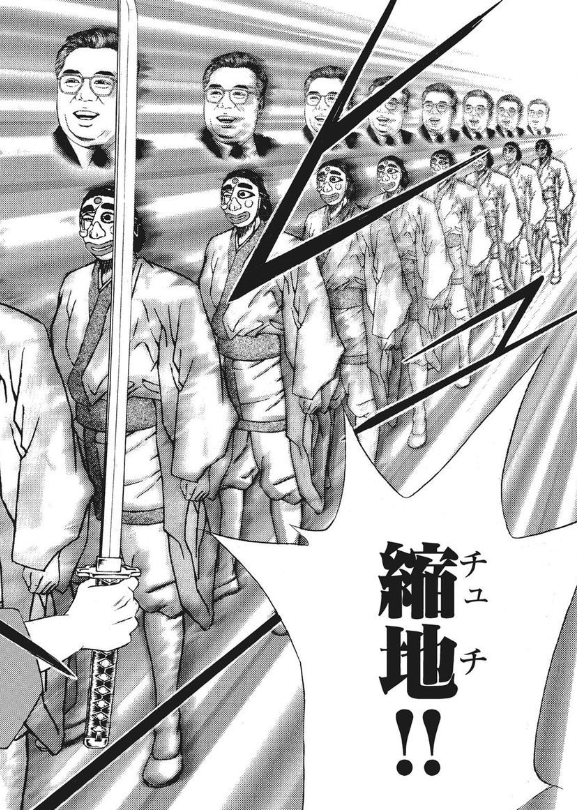
The artist is credited as one 山戸大輔.
certainly one of the finest 釣り針 / 釣魚 / bait material made in a long time
among some of the hottest takes i've seen in the wild are:
- 漢字 (all of them) is a japanese invention https://www.amazon.co.jp/漢字を発明したのは日本人だった-―虚構の中国4000年史-超知ライブラリー-幸-沙代子/dp/4198602654
Apparently there are enough people who engage in such 「research」 to the point where the humanities department of the university of toyama has come up with this fact-checking article https://www.hmt.u-toyama.ac.jp/chubun/ohno/nihon.htm, and the rationale is amusingly straightfoward
- horses and tigers are indigenous to china, which would explain why 馬 is the radical for characters like 驅 and 馳, because horses move fast, and the 虍 radical, which occurs semantically in characters like 虎, 虐, and 虜. you would expect basic concepts like sea, salt, waves to be extremely integral to the writing system.
language problems
-
korea has a language problem
-
「韓国人は本を読まない」
-
there is no way to represent the japanese concepts of 促音 and 長音 with hangul, and amusingly korean as a whole is often referred to as ハングル語
- an often-seen gripe is the transliteration of place names like Tokyo into 도쿄
- sinitic loanwords are often used as an example to uphold this trope, the argument goes something like koreans can't differentiate between 故郷 and 公 共, while being blissfully unaware that the 陽声韻尾
/-ŋ/usually becomes 長音 in 呉音. - 韓国語における日本語表記法の変遷過程
- [citation needed] this was allegedly a topic at the 1972 Japan–China Joint Communiqué - either side shall read proper nouns in its native reading
-
建設業界の関係者は「建設現場は日本語や各種の外来語が乱舞する代表的な場所」とし、「建設会社に就職した新入社員や日雇い労働者は、仕事の指示が聞き取れず、意思の疎通もできないため、現場で使用されている日本式用語を覚えるほかないという悪循環が続いている」と話した。according to an article in the japanese edition of the chosun ilbo in 2005
- it is most probably a language purist movement. also, there is nothing inherently wrong with using lots of loanwords. Try doing science in anglish...
-
japan has a language problem
- without baekje scholars everyone would be illiterate
- the people behind http://kanamozi.org/ should have a chat with the "hangul cannot represent long vowels" guys...
- 慣用音 like mou in 消耗 which takes upon the reading of 毛 and not the actual 反切 reflex of 呼到, which even in modern day jp would be こ+とう = こう are indicative of [some character deficit]
- they got this "right" with 耗 弱, however...
- french people think the same way of calques into english
- Thirty-four-year-old Takeshi Inoue struggles with many of the daily tasks most people don't think twice about. He can't read newspapers, or even street signs, and he doesn't know how to write his address. https://www3.nhk.or.jp/nhkworld/en/news/backstories/583/
- good for him, no one can read all the 難読地名 either
-
china has a language problem
- the usual shitting on simplified chinese
- i'm tempted to start shilling simplified chinese because of how silly i find the arguments which end up invoking SOVL are. the vast majority of characters are phonosemantic anyways. and more often than not it's the radical that is the semantic part. any "greater understanding" to be had upon learning the unsimplified form is always a post-hoc matter after it has been learned in rote. this is a rant for another blog post, however...
- mandarin phonology sucks / mandarin does not preserve 入聲
- mandarin (or whatever passes for it now) is linguistic cultural imperialism
- putonghua != beijing dialect. Here's at least one example of a beijing dialect term that didn't make it into putonghua https://en.wiktionary.org/wiki/雞賊. Not all of the 儿化音 made it into putonghua, either.
- the usual shitting on simplified chinese
modesty
-
the hanbok of the joseon period was gradually shortened until everyone walked around bare-breasted. http://www.koreatimes.co.kr/www/news/nation/2011/10/113_96899.html
- some chinese tabloids extrapolate it to "even the japanese couldn't bear the immodesty and made them cover up"
-
「After the incident in question, Genji tries to see the lady (空蝉) two more times. The first time, she finds out about his arrival and takes refuge into another wing of the house, where she surrounds herself with her ladies-in-waiting. Frustrated, Genji ends up taking her younger brother to bed, as her replacement. This episode is considered the sole explicit example of homosexual relations in the tale.」
eating shit
- ttongsul
- virgin boy egg
- https://ja.wikipedia.org/wiki/日本における人糞利用
- omorashi
i'm going to stop here because i've spent more time than i care to admit racking my brains and scouring through my history for this nonsense. every single point here could be worthy of an entire thesis; i'll ration my limited energy to the more profound ones.
speaking of idealization of violent outbursts, Cho Seung Hui is often referred to as "General Cho" in incel / otherwise disgruntled circles: https://koreajoongangdaily.joins.com/2015/09/03/socialAffairs/ https://www.chosun.com/site/data/html_dir/2017/04/14/2017041402236.htmlGraphic-online-culture-debated-after-teens-arrest/3008768.html ↩︎
https://www.youtube.com/watch?v=uYOVA6bSA_g a hilarious bit in which korean and chinese guests duke it out on a japanese TV show; the koreans start getting irritated and describe the chinese as 「ちょっと大袈裟」, and when asked for clarification, mention:
- なになにも千千万万年・何万里 c.f. the great wall is known in modern china as the 万 里 长 城, phrases like 鵬程萬里, where 10000 is merely used as a metaphorical number too large to fathom
- 4000 years of ramen
- 4000 years of 蒸し 鶏
- 4000 years of movie making
then, having been set up, the chinese guest doubles down, and goes DAKARA 5000 NEN DESU YO
from my observations, chinese netizens usually agree, or are at least generally willing to concede, that the 夏 and 商 dynasties are mythical(夏商不可考); in particular the 夏 having been founded by 鯀 (lit: big fish), the father of 禹, who personally went to the 黄帝 to beg for magic soil that would hold when despite his father's 「engineering prowess」 all attempts to build dams failed.
They usually agree on a more modest 4000 years.
A 清-era account of the whole affair can be found here https://zh.wikisource.org/wiki/歷朝史案/卷01#鯀禹治河 ↩︎